|
|
SEAPAVAA Newsletter |
4th SEAPAVAA Conference - Statement of Conclusions
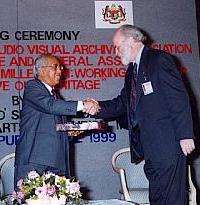
The Fourth Conference and General Assembly of the South East Asia-Pacific Audio Visual Archive Association (SEAPAVAA) was held in Kuala Lumpur, Malaysia from 19 to 24 April 1999. Zeroing in on the theme "AV Archiving in the New Millennium -- Working Together to Preserve Our Heritage", the conference was a "first" of sorts: it was the first time that Kuala Lumpur hosted the conference; it was the first time that SEAPAVAA took in the concerns and issues regarding audio; and it was the first time that the association took in a full member from the Pacific region. Eighty-eight delegates representing audio-visual archiving in Australia, India, Denmark, Indonesia, Laos, Malaysia, New Zealand, Papua New Guinea, Philippines, Singapore, Sweden, Thailand, United Kingdom, and Vietnam attended the conference. The participants had their hands full with the line up of activities: symposium, the general assembly meeting, film screenings, institutional visits, and a tour of Kuala Lumpur. At the general assembly meeting, new members (five full and six associates) were ratified and the association's new set of officers and council members were elected to serve for FY 1999-2001.  SEAPAVAA delegation at the welcome dinner.
Statement of ConclusionsThe following Statement of Conclusions was developed in the symposium and subsequently refined and adopted by the SEAPAVAA General Assembly on 20 April 1999. 1. The presence and emergence of SEAPAVAA is acknowledged to be beneficial to the advancement of audiovisual archiving in the region. Individuals and institutions from all countries should be enthusiastically encouraged to join SEAPAVAA and together undertake the task of enhancing and preserving audiovisual materials. 2. The conference theme, "Audiovisual archiving in the new millennium: working together to preserve our heritage", is an essential vision for the future, and for this to be tangibly realized, SEAPAVAA should work together, not only among its members but also with related organizations worldwide. 3. Countries in the region are at different levels of progress in audiovisual archiving, so efforts must be made to help all countries cooperate and share their expertise, resources, and experiences as equitably as possible. The needs of audiovisual archives in the Pacific are particularly noted - problems of climate are made worse by isolation, economic factors and the visibility of the work. SEAPAVAA members are encouraged to assist their Pacific colleagues in every way possible, and the SEAPAVAA Council should explore assistance from UNESCO and other sources. 4. Professionals involved in AV archiving, be they archivists, librarians, technicians, or formation professionals should cooperate in sharing knowledge, sharing workloads, and exploring all available means towards the objective of maintaining and preserving audiovisual materials. 5. Communication among institutions and individual audiovisual archivists is vital to the rapid advancement of our field and to the deepening of knowledge and expertise. Fraternity and cooperation should be built among members and with related organizations through:
6. SEAPAVAA should work with other organizations having similar objectives and aspirations such as IASA, AMIA, FIAF, FIAT, ICA, PARBICA, SARBICA, PIMA, PIALA, IFLA, and UNESCO. In particular, the "Memory of the World" program has important implications for audiovisual archives in the region, and for the status and visibility of the audiovisual heritage in each country. 7. Each country should work for the creation and recognition of a national focus point for its audiovisual archiving, whether it be a single institution or a coordinated group of institutions. SEAPAVAA members and council should continue to encourage this development wherever it does not yet exist. 8. Well targeted training across the region remains a critical need to be pursued. This can take diverse forms such as:
9. Repatriation of material (that is, return of originals and/or copies to the country of origin) is crucial to building national audiovisual collections in the region, especially in countries which are former colonies. Identification of sources and holdings overseas, as well as legal ownership of both physical property and rights, should proceed even if immediate repatriation is not technically practicable. Repatriation of legal rights as well as physical copies is desirable. 10. The audio heritage is fragile and is disappearing as rapidly as the moving image collections. AV archives should include the audio heritage - such as radio, oral history, and published sound recordings - in their frame of reference and actively encourage its preservation either by themselves or by other institutions. SEAPAVAA comprehends all forms of moving image and/or recorded sound and related materials and, therefore, audiovisual archives which cover this entire spectrum as well as those which focus on a particular part of it. Within the region there is an economic argument for combining sound and moving image archiving within a single institution. 11. A directory of resource persons within the region needs to be developed and available to assist in the sharing of skills and advice. 12. Every effort should be made to raise the profile of SEAPAVAA both within our region and internationally, and to interact dynamically with other heritage sectors. This is to be done through outreach, publicity, networking, and strategic partnerships with related organizations, programs, and projects. 13. AV resources should be promoted and used in the region like other archives and collections, in traditional contexts such as community events, outreach activities like exhibitions, theme expositions, and special events. This will improve their exploitation in society as heritage sources. 14. Although every institution has its individual regulative needs, the requirements of working together point to the need for standard definitions and terminology that can be used commonly by those working in audiovisual institutions and archives across the region. The UNESCO document "A Philosophy of Audiovisual Archiving" should be regarded as embodying the guiding standards, definitions and terminology for audiovisual archives in the South East Asia-Pacific region.
|