
|
|
SEAPAVAA Newsletter |
|
Advanced training on vinegar syndrome and mold-affected films
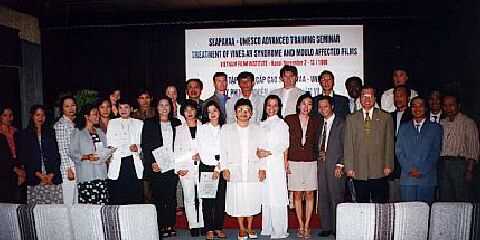
Participants and resource persons at the Hanoi seminar Twenty-five delegates from the SEAPAVAA member institutions in Indonesia, Laos, the Philippines, Singapore, Thailand, Vietnam and Pacific countries Fiji and Papua New Guinea participated in the SEAPAVAA-UNESCO Advanced Training Seminar on the Treatment of Vinegar Syndrome and Mold Affected Films. This is the first project implemented jointly by the SEAPAVAA and the United Nations Educational, Scientific and Cultural Organization (UNESCO) through the SEAPAVAA Technical and Training Committees in cooperation with the Vietnam Film Institute (VFI), the Philippine Information Agency (PIA), and the ScreenSound Australia. Vietnam Vice Minister of Culture and Information, Mr. Nguyen Trung Kien, who gave the keynote address at the opening ceremony, expressed appreciation to the organizers and confidence that the training seminar will improve the region's capability in film preservation. Held at the VFI in Hanoi, Vietnam from 2-13 November 1998, the seminar had film preservation experts from the VFI, the PIA, and the NFSA as resource persons. The course curriculum included lectures, discussions, hands-on activities, demonstration methods to impart the technical knowledge and skills (at the cognitive, affective, and behavioral levels) on the different aspects of film restoration and preservation. During one of the workshop sessions, course director Mick Newnham of ScreenSound Australia was thrilled to see a Laotian, a Fijian, a Papuan, and two Filipinos working together preserving a mold encrusted film as envisioned the way it should be by SEAPAVAA. Throughout the seminar, the delegates were encouraged to identify and discuss their strengths and concerns. At the end of the course, recommendations on the national and regional levels were formulated to help guide concerned authorities and decision-makers and for endorsement to appropriate SEAPAVAA working groups and committees. The recommendations included continued training programs, establishment of communication networks, sharing of available resources, and promotion of awareness in audiovisual archiving. With the successful outcome of the seminar, SEAPAVAA looks forward to a continued interest in and commitment to audiovisual preservation in Asia and the Pacific and, consequently, a greater chance for the survival of the region's audiovisual heritage.
|